Collecting rake
A rake — also called a tournament fee — is an amount charged on top of the buy-in that goes to the organizer rather than into the prize pool.
You will see it written as $100 + $10: the player hands over $110, the prize pool gets
$100, and the house keeps $10 towards the cost of running the event.
Rake requires an active Commercial licence. That is not an arbitrary restriction: charging a fee is by definition commercial use. See Commercial licensing.
Turning it on
Rake lives in step 1 of the tournament wizard, next to the buy-in:
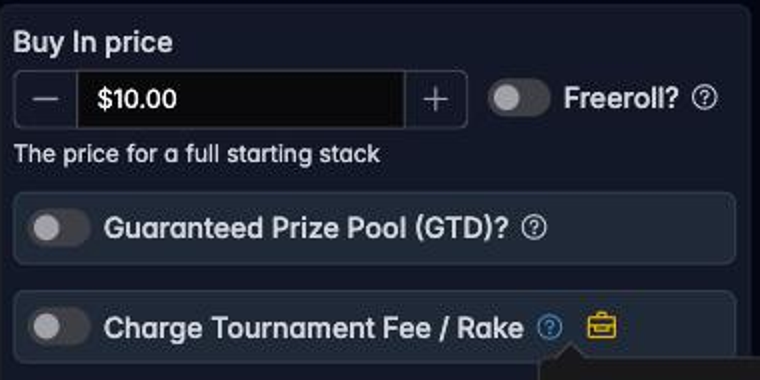
The gold briefcase marks it as a commercial feature. The ? beside it explains the concept in the app itself:
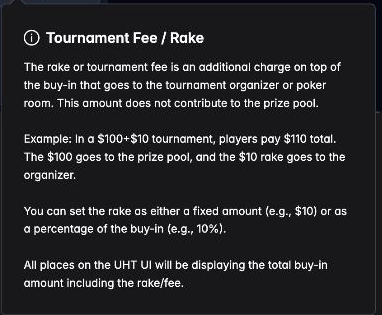
Switch the toggle on and the fee settings appear.
Setting the amount
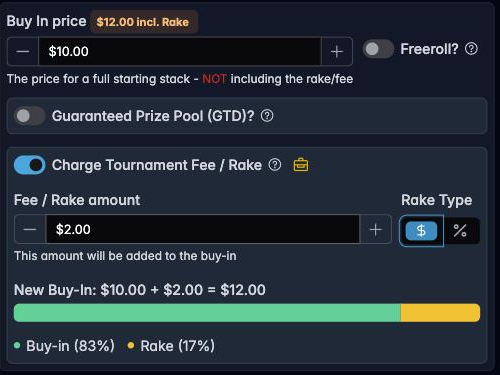
Fee / Rake amount is what you charge. Rake Type decides how it is read:
- $ — a fixed amount. $2 on every entry, whatever the buy-in.
- % — a percentage of the buy-in. 10% on a $50 buy-in is $5; on a $100 buy-in it is $10.
Fixed is the usual choice for a club running one buy-in level. Percentage is more useful if you reuse one configuration across events of different sizes.
As you type, UHT shows the result:
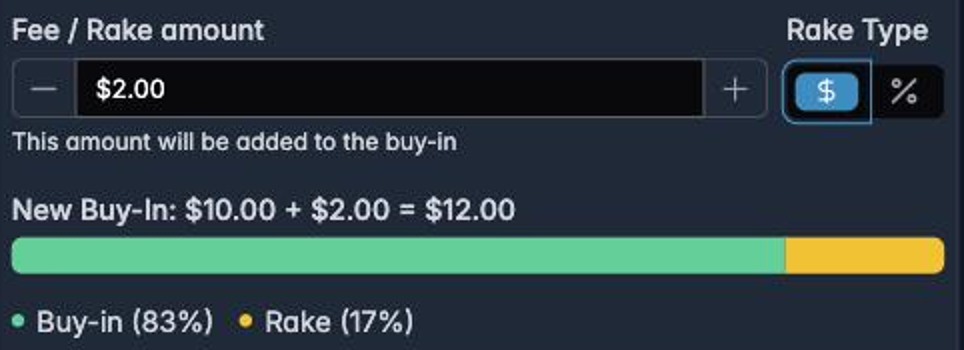
New Buy-In: $10.00 + $2.00 = $12.00, with a bar showing the split — 83% to the prize pool, 17% to the house. That bar is worth a glance before you commit: a rake that looks small in isolation can be a large share of a low buy-in.
What changes once it is on
Players pay the total. Everywhere UHT asks for or displays a buy-in, it shows the full amount including the fee. In the example above, players pay $12.
The prize pool does not include it. Four entries at $12 produce a $40 prize pool, not $48. The remaining $8 is your rake.
The buy-in field still means the prize-pool part. Note the wording under the Buy In price field: "The price for a full starting stack — NOT including the rake/fee". You enter what goes into the pool; UHT adds the fee on top. A badge beside the field shows the total players will actually pay.
Re-entries and rebuys are raked too, on the same terms, so a re-entry-heavy event produces proportionally more.
Seeing what you collected
The rake total is not something you have to work out on paper. A tournament report includes a House Earnings Summary with rake collected, guaranteed-pool overlay cost and net profit or loss for the event.
That is the pairing worth knowing about: rake is how you charge it, and the report is how you account for it.
Practical advice
Tell players the split. "$10 + $2" is understood everywhere in poker and takes two seconds to say. Quoting only "$12" and letting people discover the prize pool is smaller than they expected causes arguments that are entirely avoidable.
Check your local rules. Charging a fee to run a card game is regulated in many jurisdictions, and the rules differ sharply between private clubs, licensed venues and charity events. UHT does not know where you are or what applies to you.
Consider a guaranteed pool instead. If your aim is to make the event attractive rather than to earn from it, a guaranteed prize pool (also in step 1) may serve you better than a fee.
Next
- Tournament reports — the profitability figures rake feeds into
- Commercial licensing — when you need the licence
- Pricing — what a Commercial licence costs