Chopping the prize pool
Sooner or later a tournament reaches the point where the remaining players would rather divide the money than play it out. It is late, the blinds are enormous, and everybody has work in the morning.
That is a chop — or a deal — and UHT works out the numbers for you.
Opening the chop dialog
Chopping happens in the Players dialog. The Chop button appears once the tournament is under way and at least one player is out:
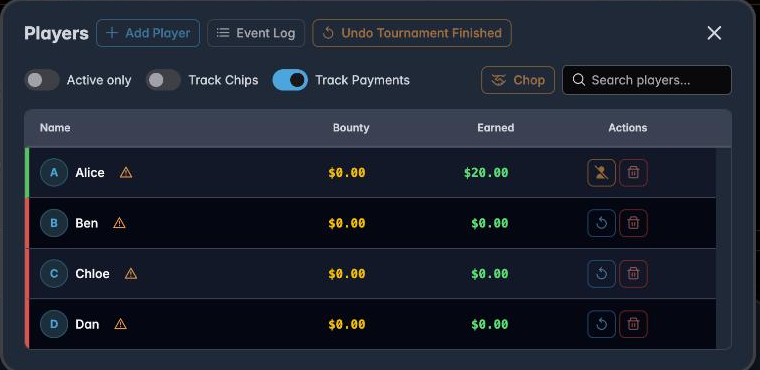
Its tooltip states the scope plainly: split remaining prize pool between active players. Players already eliminated keep whatever they have already been awarded; the chop divides what is left.
The four methods
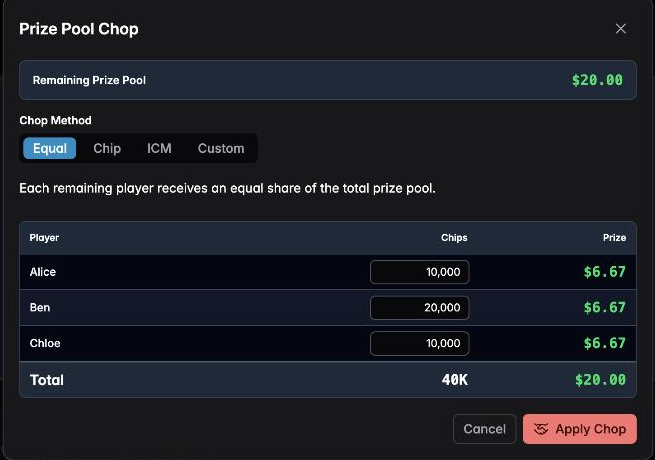
The dialog shows the Remaining Prize Pool, the method selector, an editable chip count per player, and the resulting prize. The total row confirms the amounts still add up.
Enter the chip counts first. Three of the four methods use them, and UHT cannot see the table.
Equal
Each remaining player receives an equal share of the total prize pool.
$20 between three players is $6.67 each, whoever is winning.
The simplest deal, and a reasonable one when stacks are close or the players simply want it over with. It is also the only method that ignores chip counts entirely.
Chip
Prize pool is distributed proportionally to each player's current chip count.
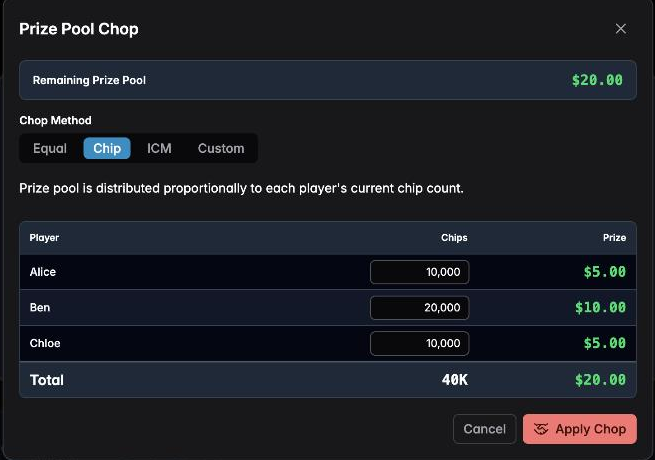
Ben holds 20,000 of the 40,000 chips in play, so he takes $10.00 of the $20.00; the two players on 10,000 each take $5.00.
Straightforward and easy to explain, but it overpays the chip leader relative to their real chances — in a tournament, twice the chips does not mean twice the equity.
ICM
ICM (Independent Chip Model) calculates the expected monetary value of each stack based on finishing probability.
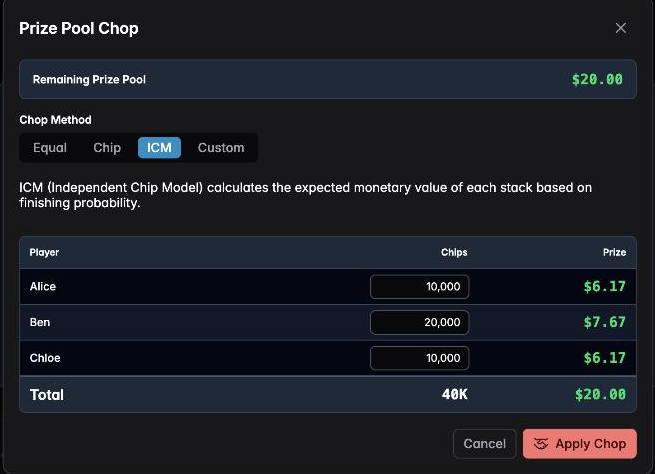
The same stacks now pay $7.67 to the leader and $6.17 to each of the others. Compare the three methods on identical numbers:
| Player | Chips | Equal | Chip | ICM |
|---|---|---|---|---|
| Ben | 20,000 | $6.67 | $10.00 | $7.67 |
| Alice | 10,000 | $6.67 | $5.00 | $6.17 |
| Chloe | 10,000 | $6.67 | $5.00 | $6.17 |
ICM sits between the two, and that is the point. It reflects the fact that a big stack is an advantage but not a guarantee, and that the shorter stacks are not yet out. ICM is the standard method in professional poker, and it is the fairest default for a serious game.
Custom
Specify a custom percentage for each player. Percentages must sum to 100%.
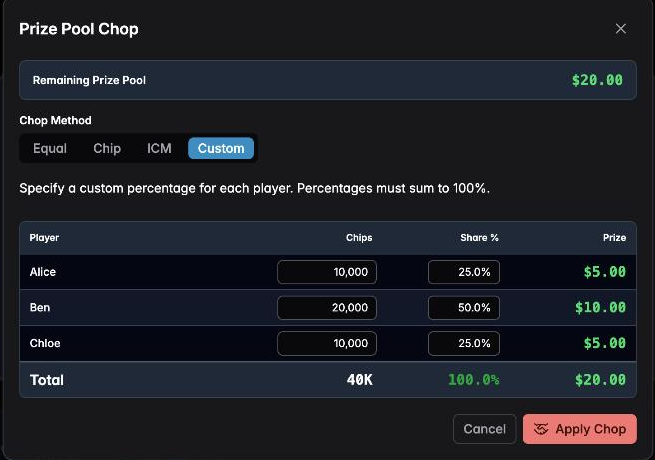
A Share % column appears and you type whatever the table agreed. UHT holds you to 100% — the total turns green when it balances.
Use this when the players have negotiated their own deal, which happens more often than the theory suggests. "Chip chop but the leader gives up a bit so we can all go home" is a real outcome, and Custom is how you record it.
Applying the deal
UHT confirms before doing anything:
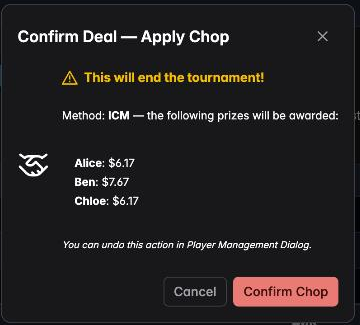
Three things are worth reading on this screen:
- This will end the tournament. A chop is a finish, not a pause.
- The exact payouts are listed by name — read them out to the table before confirming.
- You can undo this from the Player Management dialog if you get it wrong.
Press Confirm Chop and the tournament finishes.
What the standings show afterwards
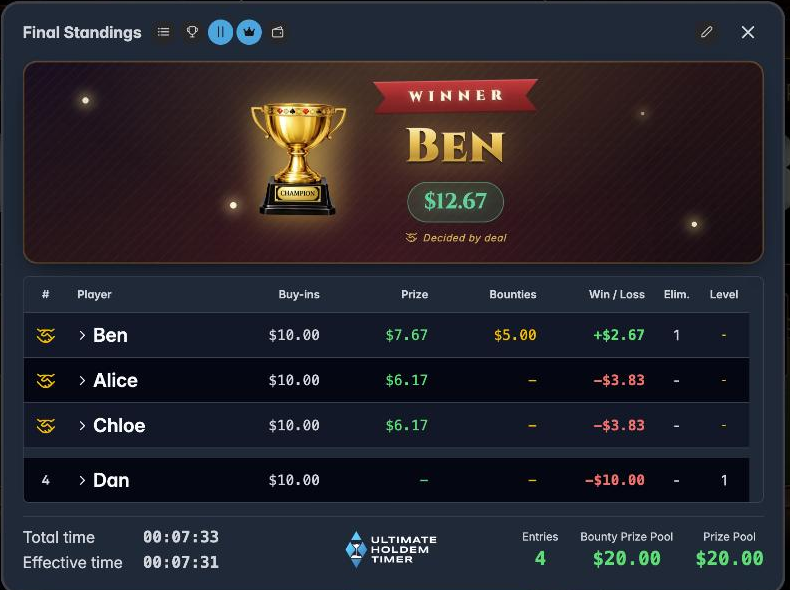
The chopped players are marked with a handshake, and the winner's card reads Decided by deal rather than implying they won outright. Everyone's prize is the deal amount.
The table underneath gives you the settle-up figures:
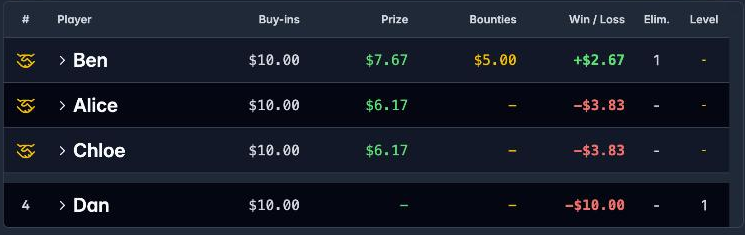
Note that bounties are separate from the chop. In the example, Ben collected $5.00 in bounties during play; the chop divided the $20.00 prize pool only. That is correct — a bounty is already won when it is collected, and is not on the table in a deal.
The deal is also written into the event log, and a tournament report records which method was used.
Running a chop well
Stop the clock first. Pause the tournament before opening the dialog. Negotiations take longer than anyone expects, and blinds rising mid-discussion changes the terms of the deal.
Count the chips properly. Every method except Equal depends on the counts you type. Get them right before opening the dialog rather than guessing.
Show the numbers. Turn the phone round. A deal everybody has seen calculated is a deal nobody argues about afterwards.
Agree the method before the amounts. Arguing about ICM versus chip chop is a conversation about principle; arguing about $2.50 is a conversation about money, and it goes much worse.
Remember what is not included. Bounties already collected are not part of the pool. If the players intend to divide those too, use Custom and adjust the percentages.
Next
- Managing players — the dialog the chop lives in
- Tracking payments — settling up after the deal
- Tournament events — undoing a chop