Bounty tournaments
In a bounty tournament, part of each buy-in becomes a price on that player's head. Knock them out and you collect it — cash in hand, that evening, whether or not you go on to make the final table.
It changes how people play. Short stacks get called more often. Nobody folds their way to a quiet ninth place. It's the single easiest way to make a friendly game livelier.
How the money splits
Normally every penny of the buy-in goes into the prize pool. With bounties on, the buy-in is split in two:
- Part goes to the prize pool, paid out to the top finishers as usual.
- Part becomes that player's bounty, paid immediately to whoever knocks them out.
So a $10 buy-in with a 50% bounty share means $5 to the prize pool and $5 on that player's head. Ten players gives a $50 prize pool and $50 circulating as bounties.
This is a split, not an extra charge. Nobody pays more than the buy-in — the prize pool is simply smaller, because that money is being paid out during the game instead of at the end.
Setting it up
Bounties live in the tournament wizard, step 6 — Track Players & Bounties.
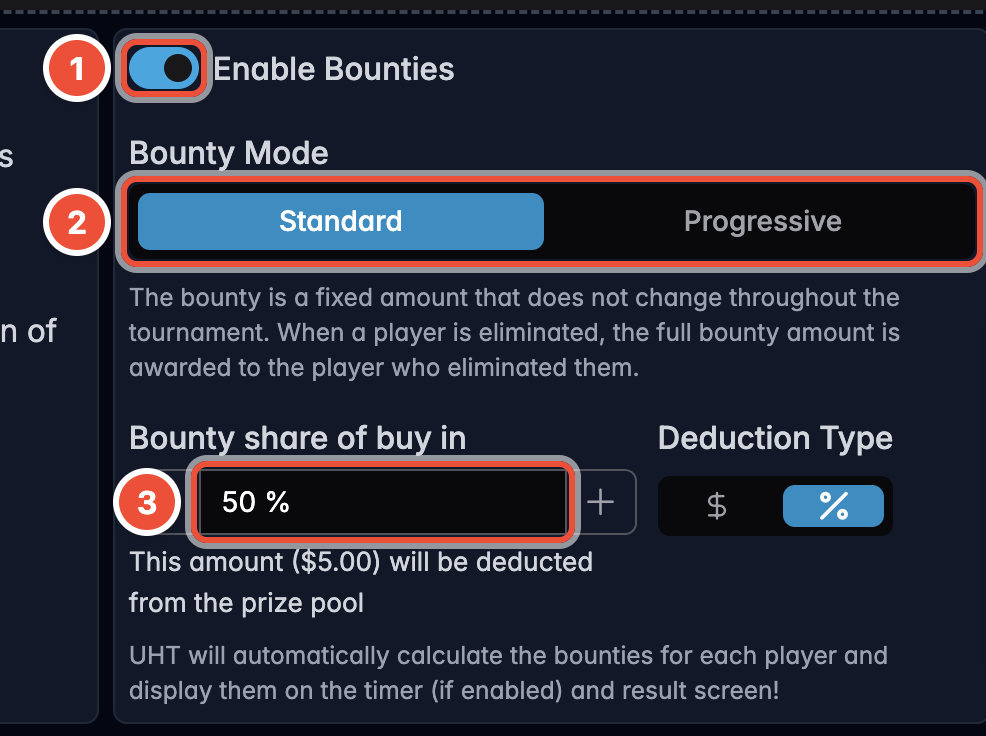
- Enable Bounties. Turn this on first; the rest of the options appear with it.
- Bounty Mode. Standard or Progressive — see below.
- Bounty share of buy in. How much of each buy-in becomes the bounty. Use the Deduction Type buttons beside it to give either a percentage of the buy-in or a flat cash amount. UHT shows the resulting figure underneath, so you can see exactly what comes out of the prize pool before you commit.
Bounties are paid to a person, so UHT has to know who is at the table. With Track Players on you name each player as they buy in, and UHT can then record who knocked out whom and total up each player's winnings at the end. Without it there's nobody to pay.
For the same reason, enabling bounties pins Track Knockouts on and hides its switch: every bust has to name an eliminator, because that is who gets paid. Switch bounties off again and the choice comes back — see Track Players, and Track Knockouts.
The two modes
Standard
The bounty is a fixed amount that never changes. Knock someone out, collect their whole bounty, done.
With a $5 bounty, every player is worth $5 all evening — the chip leader and the short stack alike.
Use it for: most home games. It's simple, everyone understands it immediately, and the maths never surprises anyone.
Progressive
The bounty grows as players collect scalps. When you knock someone out, you take half their bounty as cash and the other half is added to your own — which makes you a bigger target.
Start everyone at $5. Knock someone out and you pocket $2.50 while your own head becomes worth $7.50. Knock out a player who's already collected a couple of bounties and the payday is much larger.
Use it for: a longer game, or a group who've played plenty of standard bounty nights and want something with more of an arc. It rewards aggression and gives short stacks a reason to gamble at the big stacks.
Running the tournament
Once you start, UHT works out every player's bounty automatically and tracks the rest.
Adding players
Open the tournament controls (the menu button on the display) and you'll find Player Management:
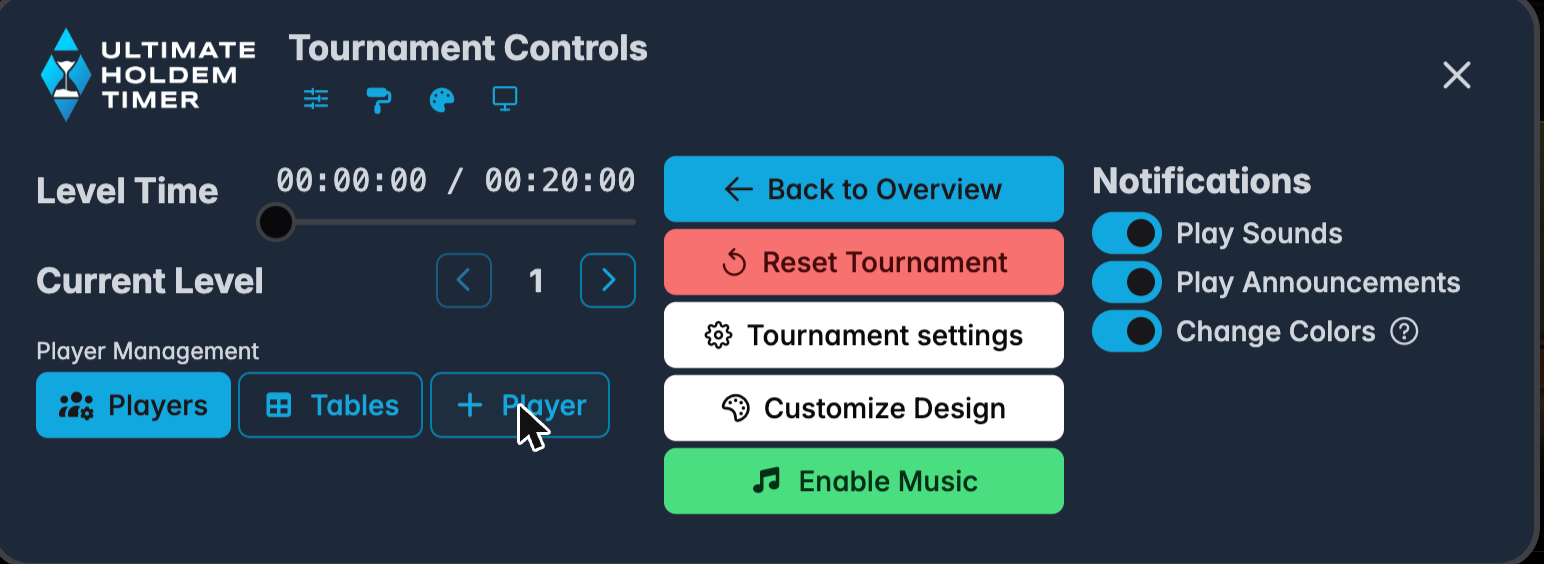
Press + Player as each person buys in:
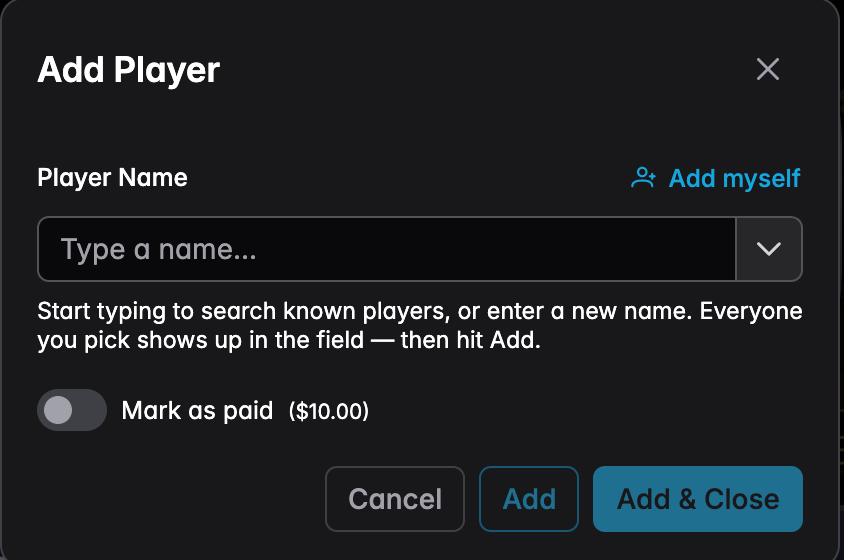
Type a name — UHT suggests players you've had before, so regulars are one click. Mark as paid records that they've handed over the buy-in, which is handy when someone says they'll settle up later. Add keeps the dialog open for the next person; Add & Close finishes.
Open Players to see everyone:
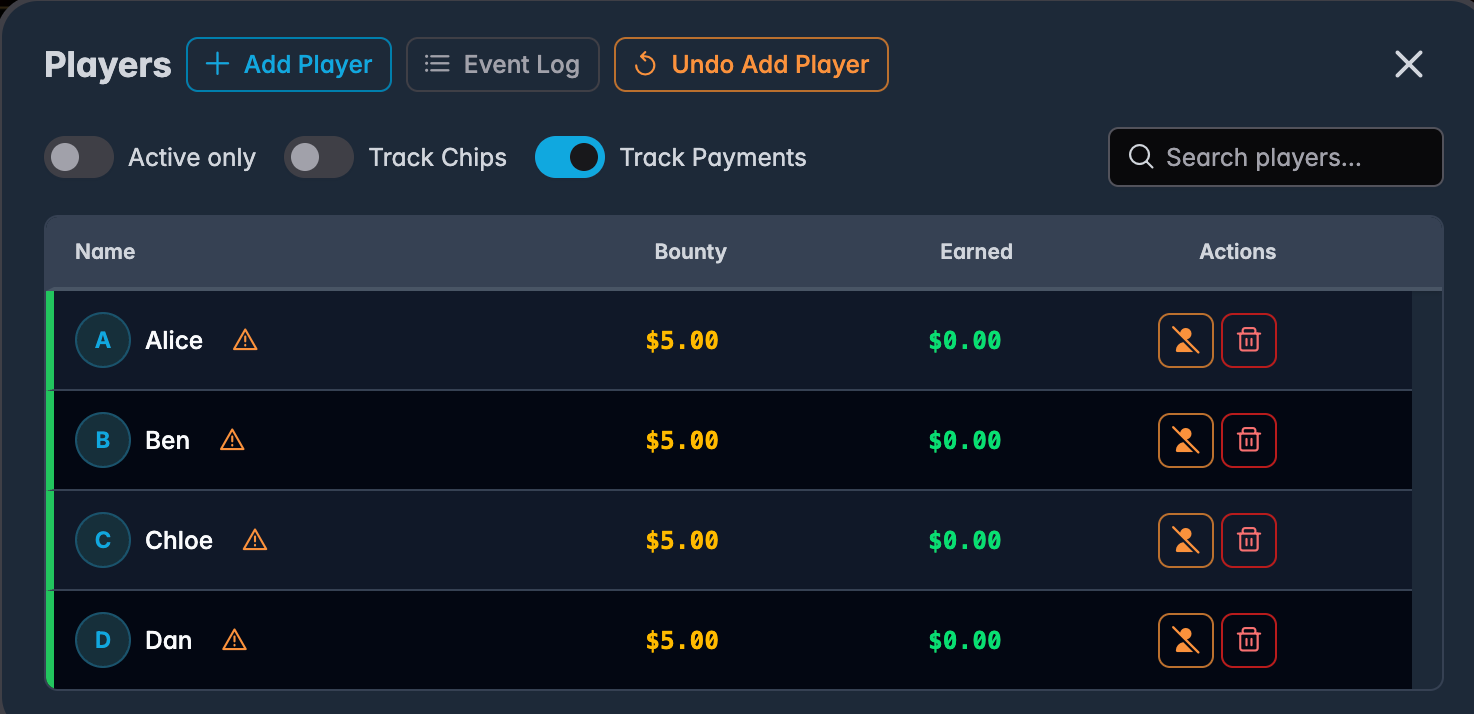
Every player carries a Bounty — here $5.00 each, half of the $10 buy-in — and an Earned column that starts at zero and grows as they knock people out.
Knocking someone out
Press the bust button on that player's row:
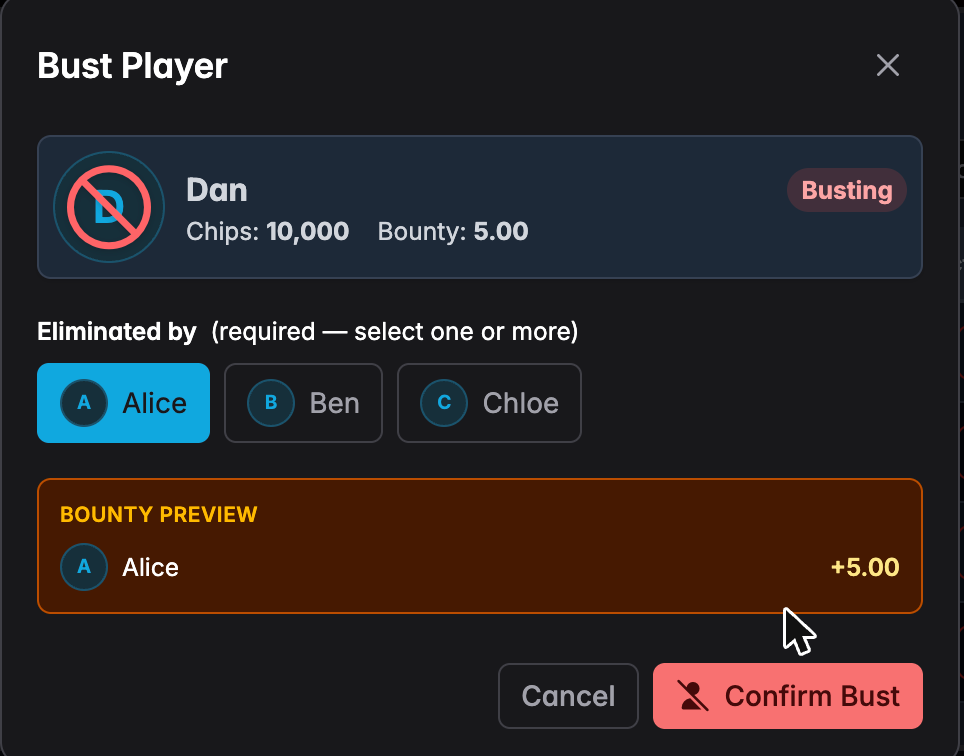
Pick who eliminated them. UHT shows a bounty preview so you can see exactly who is about to be paid what before you commit.
You can select more than one eliminator — if two players got them all-in together, tap both and the bounty is split between them.
Press Confirm Bust and the money moves:
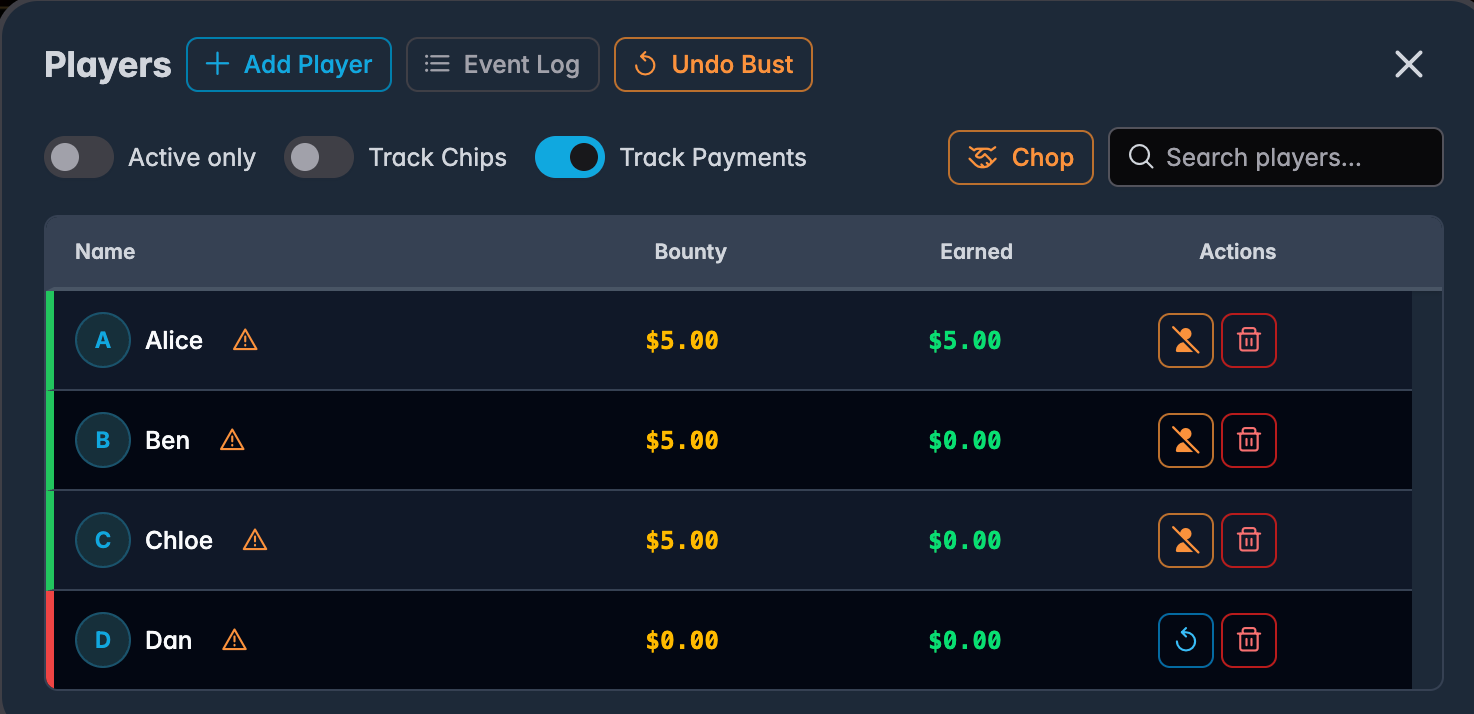
The busted player's row turns red and their bounty drops to zero; the eliminator's Earned goes up. Got it wrong? Undo Bust at the top reverses it.
At the end
When the last player is out, UHT shows the final standings:
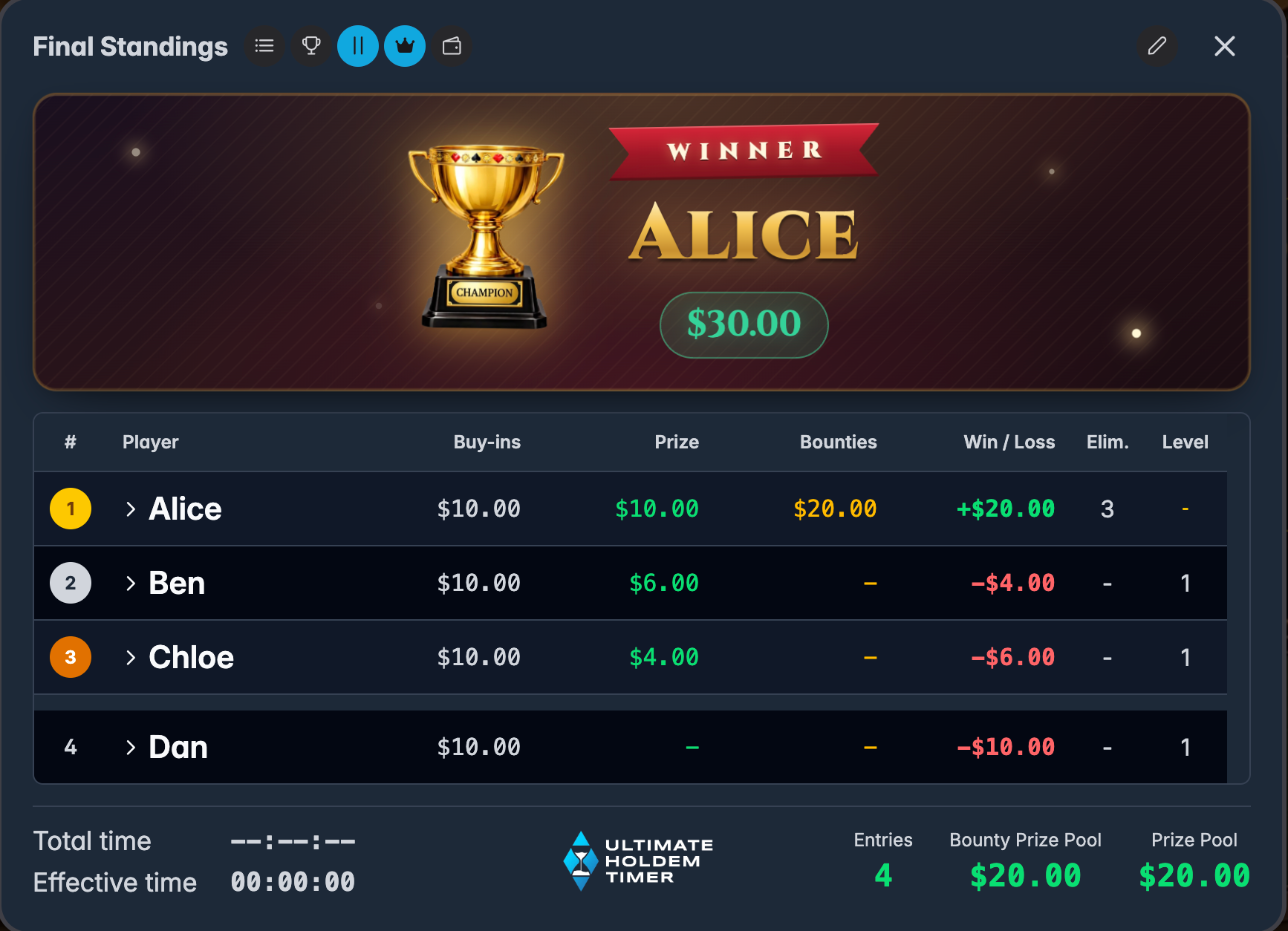
This is the screen you settle up from. For each player it shows what they paid in, what they won in prizes, what they collected in bounties, and the resulting win or loss.
The example above makes the split concrete: four players at $10 each is $40 in, which became a $20 prize pool and a $20 bounty pool. Alice won the tournament and collected all three bounties, so she finishes $20 up while the $10 prize money alone wouldn't have covered it.
If somebody re-enters, they buy in again, so a fresh bounty goes on their head. That's usually what people expect, but it's worth saying out loud at the table before you start.
Will my display show bounties?
Only if the design you chose has somewhere to put them. Designs differ — one may show a bounty leaderboard while another has no room for it.
You don't have to guess: the wizard tells you on step 8 if something you've configured can't be shown by the design you picked. Nothing breaks either way — the tournament runs identically, the numbers just aren't on screen.
If your design doesn't show them, either pick one that does, or add a bounty component yourself — see Display designer.
Before your first bounty night
- Say the format out loud. Especially the split. Somebody will otherwise assume the prize pool is the full buy-in and be annoyed at payout time.
- Have cash to hand. Bounties are paid during the game, not at the end. Small notes.
- Start with Standard. Run progressive once everyone's comfortable.
- 50% is a lot. It's the default and it plays well, but it halves the prize pool. If your group cares about a big first prize, try 20–30% instead.
Next steps
- Getting started — the basic tournament walkthrough
- Display designer — put bounty information on screen
- Something not working?